
How Our PEERS® Program Is Classified and Funded Under the NDIS
If you're a parent, participant, support coordinator, or allied health professional searching for autism supports in Ballarat, you've probably noticed that not all "social skills" services are described — or funded — the same way. At Unified Care Solutions, we deliver PEERS® (Program for the Education and Enrichment of Relationship Skills), a structured, evidence-based social skills program for autistic teenagers and children, and we want to be completely transparent about how we classify and bill it under the NDIS.
This post explains the question we set out to answer, the determination we reached, and exactly what it means for anyone involved in a participant's care in the Ballarat region.
The Question We Set Out to Answer
Our Registered Nurses are PEERS® Certified Providers. Their eligibility for that certification is based on their professional registration as Registered Nurses. That created a genuine question with no obvious, pre-written answer in current NDIS pricing documents:
Is a structured, evidence-based social skills program — delivered by a Registered Nurse — a therapy support, or a disability-related health support?
The NDIS currently prices two distinct things that can look similar from the outside:
Therapeutic Supports — evidence-based supports delivered by allied health professionals to build or maintain a participant's skills and independence, in areas such as communication, interpersonal interaction, and psychosocial functioning.
Disability-Related Health Supports — supports, including nursing care, that help manage the health-related impact of a participant's disability (for example, wound care, continence, dysphagia, or medication management).
Registered Nurses are explicitly recognised NDIS providers for the second category. They aren't currently named on the NDIS's list of "therapy types" for the first — even though NDIS Guidelines state that therapists must be AHPRA-registered (for regulated professions) or peak-body accredited (for self-regulated professions), and our Registered Nurses meet that test in both ways.
We didn't want to guess. We reviewed the NDIS Operational Guidelines on Therapy Supports and Disability-Related Health Supports, the current NDIS Pricing Arrangements and Price Limits (PAPL), the Department of Health, Disability and Ageing's Defining Therapy Supports consultation paper, and the professional standards that govern our Registered Nurses' practice — including the Nursing and Midwifery Board of Australia's position on nursing specialty recognition, and the Professional Association of Nurses in Developmental Disability Australia's (PANDDA) Standards for Nursing Practice.
Our Determination
PEERS® and comparable structured, evidence-based social and communication skills programs delivered by our Registered Nurses are Therapeutic Supports, not Disability-Related Health Supports.
This comes down to what the support does, not who delivers it. PEERS® builds social and communication skills — it doesn't treat, manage, or offset a health condition. That places it squarely within the purpose of therapy supports under NDIS Guidelines, regardless of the professional background of the person delivering it.
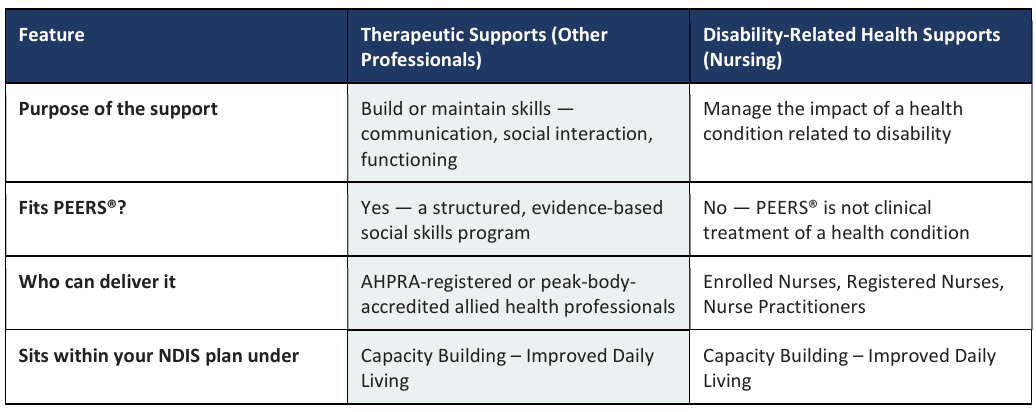
Summary Table of Differences in NDIS Therapeutic Supports vs Disability-Related Health Supports from a Nurse
Why Our Registered Nurses Are Eligible to Deliver Social Skills Therapy
NDIS Guidelines require a therapist to be AHPRA-registered (for a regulated profession) or accredited by a relevant peak body (for a self-regulated profession). Our Registered Nurses meet this requirement through three linked layers of professional standing:
AHPRA registration as a Registered Nurse — satisfying the base requirement for a regulated health profession.
PANDDA Standards for Nursing Practice — the peak-body framework for the recognised nursing specialty of intellectual and developmental disability nursing, which the Nursing and Midwifery Board of Australia recognises as the appropriate Australian mechanism for identifying nursing specialty practice. These Standards explicitly describe the specialty as therapeutic, skill-focused, and oriented around NDIS practice.
PEERS® Certified Provider status — program-specific competency in the evidence-based intervention itself.
Together, these three layers give a clear, documented answer to "why is this person qualified to deliver this therapy" — made stronger, not weaker, by being explicit about the nursing pathway rather than obscuring it.
What This Means in Practice
Our Service Agreements, referral information, and billing practices reflect this determination:
Supports such as PEERS® are described and billed as Therapeutic Supports, drawn from a participant's Capacity Building – Improved Daily Living budget — the same category most participants already use for allied health therapies like speech pathology, occupational therapy, or psychology.
Where a participant also has a genuine, separately identifiable disability-related health need — for example, a co-occurring clinical care need addressed in the same engagement — that portion is billed separately and accurately as a Disability-Related Health Support. The two are never blended into a single, ambiguous claim.
Updated Service Agreements name the specific support, its purpose, and the professional basis for its delivery, so the link between the claim and the support is clear on its face.
There is no change to how PEERS® or other therapeutic programs are delivered clinically. This is a change in classification and documentation, not in the care itself.
What This Means for You
Participants and representatives Your sessions, goals, and the way your Registered Nurse works with you aren't changing. Your invoices and statements will describe these supports as therapy, drawn from your Improved Daily Living budget, rather than as nursing health support. If your plan currently funds this support under a health-support line item, we'll work with you — and your support coordinator, where relevant — to make sure your plan correctly reflects therapy funding, so there's no disruption to your service.
Support coordinators Please budget and track these supports against Capacity Building – Improved Daily Living (Therapeutic Supports), not Disability-Related Health Supports, going forward. If a participant's current plan doesn't have sufficient Improved Daily Living funding to reflect this change, we're happy to provide supporting evidence — including the professional basis for delivery set out in this article — for a plan variation or reassessment request.
Allied health and other referrers When referring a participant to us for PEERS® or comparable programs, please describe the referral as a request for a therapeutic, capacity-building support (social and communication skills), rather than a health-management referral. We're glad to provide further detail on the professional standards underpinning our Registered Nurses' delivery of these programs, for use in your own reports or recommendations.
Why We're Sharing This
We're making this determination and communicating it proactively for three reasons:
Justified care — every support we bill should be described the way it's actually delivered, with a clear, documented basis for who delivered it and why they were qualified to do so.
Clear communication — participants, representatives, support coordinators, and referrers shouldn't have to guess which budget a support sits under, or wonder why an invoice looks different from what they expected.
Alignment with NDIS Guidelines and the PAPL — we'd rather adjust our own documentation ahead of any query than ask a participant or the NDIA to reconcile a mismatch later.
This reflects our current, careful reading of NDIS Operational Guidelines, the Pricing Arrangements and Price Limits, and applicable professional nursing standards as at July 2026. NDIS Rules relating to the definition and categorisation of therapy supports are under active review by the Department of Health, Disability and Ageing, and we'll update this article if and when those Rules change.
Questions About Autism Support and NDIS Funding in Ballarat?
If you have questions about PEERS®, how this affects a specific participant's plan or budget, or would like the professional standards referenced above provided in writing for your own records, we're here to help.
[Contact us] through the form on this website, or email us directly at zeaton@ucsol.com.au.
This article reflects Unified Care Solutions Pty Ltd's current interpretation of the NDIS Operational Guidelines, NDIS Pricing Arrangements and Price Limits, and relevant professional nursing standards as at July 2026. Nothing in this article constitutes legal or financial advice.