
Social Skills Development: What Does the Research Actually Say?
For parents and allied health professionals alike, "social skills training" can mean a lot of different things - everything from informal coaching tips to fully manualised, clinically tested programs. If you're trying to find the right support for a child, teenager, or young adult, or you're deciding who to refer a client to, it's worth knowing which approaches actually have evidence behind them.
At Unified Care Solutions, our approach to social skills development is grounded in peer-reviewed research, most notably the Program for the Education and Enrichment of Relational Skills (PEERS®), developed at UCLA. Below, we've reviewed five key studies that shaped the evidence base for this approach, so you can see exactly what the research does and doesn't show.
Why Evidence Matters in Social Skills Development
Social skills difficulties are common among autistic children, teens, and young adults, and are linked to loneliness, peer rejection, and poorer quality friendships (Laugeson et al., 2009). The instinct to "just get them into a social group" is understandable, but not all programs are created equal. Manualised, evidence-based programs that have been tested in randomised controlled trials (RCTs) - the gold standard of clinical research - give families and referrers much greater confidence that a program will actually produce measurable outcomes.
Note. Reproduced from Evidence-based practice (EBP) (American Speech-Language-Hearing Association, n.d. Retrieved 22 July 2026 from https://www.asha.org/research/ebp).
The Original PEERS Trial: Teens with Autism Spectrum Disorder
The foundational study in this space is Laugeson et al.'s (2009) randomised controlled trial of PEERS, then a 12-week parent-assisted social skills intervention for 33 teens aged 13–17 with autism spectrum disorder (ASD). Teens were randomly assigned to receive the intervention immediately or after a delay (a "delayed treatment control" design), which allowed the researchers to compare outcomes between the two groups.
Compared to the control group, teens who completed PEERS showed significantly greater improvement in their knowledge of social skills, hosted significantly more get-togethers with peers, and were rated by parents as having better overall social skills (Laugeson et al., 2009). Notably, the study also found that friendship quality declined in the control group over the same period, while it held steady for teens receiving treatment — suggesting the intervention may help prevent the natural decline in friendship quality that can occur without support. Teacher-reported outcomes were not statistically significant, which the authors attributed largely to a low survey response rate from teachers rather than a lack of effect (Laugeson et al., 2009).
Extending and Replicating the Findings
A follow-up study by Laugeson et al. (2012) tested an expanded, 14-week version of PEERS with 28 middle and high school adolescents, adding new content on topics like appropriate use of humour, handling rumours and gossip, and cyberbullying. This study didn't just look at immediate outcomes — it followed participants for 14 weeks after treatment ended, to see whether gains actually lasted.
The results were encouraging. Teens who completed PEERS showed significant improvements in parent-rated social skills (including cooperation, assertion, and responsibility), reductions in autism-related social difficulties, increased knowledge of social skills, and more frequent get-togethers with peers (Laugeson et al., 2012). Importantly, nearly all of these gains were maintained at the 14-week follow-up, and some outcomes — including reduced problem behaviours — actually continued to improve after treatment ended (Laugeson et al., 2012). Independent teacher ratings, collected from a smaller subset of participants, also showed significant improvement in social skills and assertion between the start of treatment and the follow-up assessment. This durability of outcome is a critical marker of a genuinely effective intervention, rather than one that produces only short-term or artificial gains within a clinic setting.
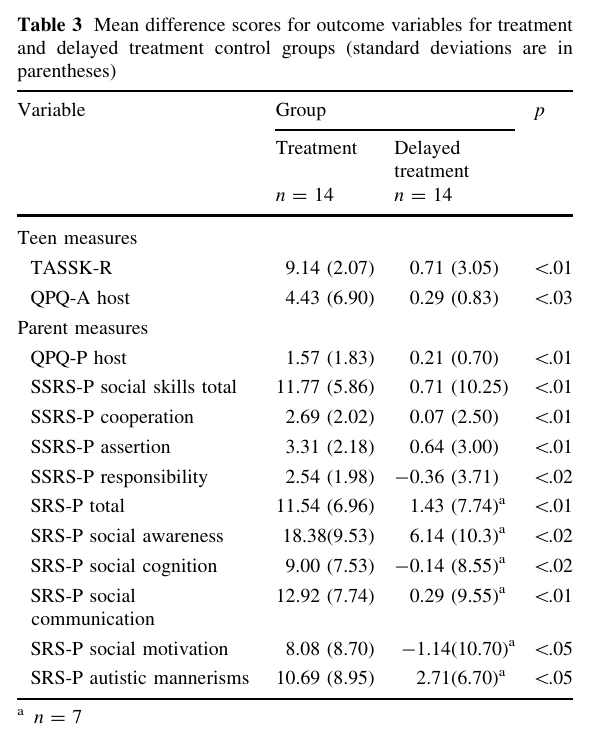
Note. Reproduced from “Parent-Assisted Social Skills Training to Improve Friendships in Teens With Autism Spectrum Disorders” by E. A. Laugeson, F. Frankel, C. Mogil, and A. R. Dillon, 2009, Journal of Autism and Developmental Disorders, 39(4), pp. 596–606 (https://doi.org/10.1007/s10803-008-0664-5).
Extending PEERS to Young Adults
Much of the earlier social skills literature focused on children and younger adolescents, leaving a gap for older individuals with ASD. Gantman et al. (2012) addressed this with a randomised controlled pilot study of PEERS for Young Adults, adapted for autistic young adults aged 18–23 and involving caregivers rather than parents specifically.
In this trial of 17 participants, young adults who completed the program self-reported significantly less loneliness and greater knowledge of social skills, while their caregivers reported significant improvements in overall social skills, social responsiveness, empathy, and the frequency of get-togethers with peers — both those the young adult hosted and those they were invited to (Gantman et al., 2012). This last finding is worth highlighting: an increase in invited get-togethers suggests genuine reciprocity in new friendships, rather than simply an increase in effort from the participant alone.
Does Social Skills Training Change the Brain?
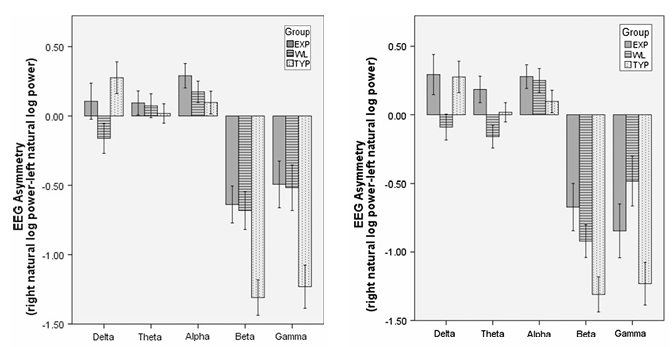
One of the more striking findings in this body of research comes from Van Hecke et al. (2013), who used EEG (electroencephalogram) recordings to examine whether PEERS produced measurable changes in brain activity, not just behaviour. In this randomised controlled trial involving adolescents with ASD and a comparison group of typically developing adolescents, the researchers measured hemispheric asymmetry in EEG activity before and after treatment.
Adolescents who completed PEERS showed a shift from right-hemisphere-dominant to left-hemisphere-dominant brain activity in the gamma frequency band, a pattern generally associated with more approach-oriented, positive social engagement (Van Hecke et al., 2013). Adolescents in the waitlist control group showed no such shift. Critically, this leftward shift was associated with fewer autism symptoms, more social contact, and greater social skills knowledge, and by the end of treatment, the PEERS group's brain activity pattern was no longer significantly different from that of the typically developing comparison group (Van Hecke et al., 2013). While the authors are appropriately cautious about over-interpreting a single study, this remains one of the first pieces of evidence that a social skills program can produce changes detectable at the neural level, not just on parent and teen questionnaires.
Note. Reproduced from “Social Skills Training for Young Adults With High-Functioning Autism Spectrum Disorders: A Randomized Controlled Pilot Study,” by A. Gantman, S. K. Kapp, K. Orenski, and E. A. Laugeson, 2012, Journal of Autism and Developmental Disorders, 42(6), pp. 1094–1103 (https://doi.org/10.1007/s10803-011-1350-6).
Does PEERS Work Equally Well for Girls?
Because autism research has historically been conducted on predominantly male samples, an important question is whether findings generalise to autistic girls and women, who are often diagnosed later and may present differently. McVey et al. (2017) directly examined this question in a study of 177 adolescents and young adults (27 female) who completed PEERS or PEERS for Young Adults.
The results were reassuring: there were no significant differences between males and females in how much they benefited from the program, whether measured through social skills knowledge, direct social contact, or parent/caregiver-rated social responsiveness and social skills (McVey et al., 2017). The authors note this doesn't mean the experience of autism is identical across genders, only that, on the measures used, girls and young women showed equivalent gains in response to treatment — an important finding for ensuring social skills services remain appropriately inclusive.
What This Means for Parents and Allied Health Professionals
Taken together, these five studies point to a few consistent conclusions:
Manualised, parent- or caregiver-assisted social skills training produces measurable improvements in social skills knowledge, quality of friendships, and frequency of peer interaction, across adolescence and young adulthood (Laugeson et al., 2009, 2012; Gantman et al., 2012).
Gains are durable, with follow-up studies showing improvements maintained — and in some cases still growing — months after the program ends (Laugeson et al., 2012).
The evidence extends across ages and genders, from adolescents through to young adults (Gantman et al., 2012), and applies as much to females as males (McVey et al., 2017).
The effects may go deeper than behaviour alone, with early evidence of associated changes in brain activity patterns (Van Hecke et al., 2013).
For allied health professionals making referral decisions, this matters. Choosing a provider who delivers an evidence-based, manualised program — rather than an informal or unstructured social group — gives clients a far stronger likelihood of a meaningful, lasting outcome.
Our Approach
At Unified Care Solutions, our social skills programs for children, teens, and young adults across Ballarat draw directly on this evidence base. If you're a parent looking for support for your child, or an allied health professional seeking a referral option grounded in genuine clinical research, we'd welcome the opportunity to talk.
For further reading on the PEERS program directly from its developers, visit the UCLA PEERS Clinic.
Get in touch through our contact form to discuss a referral or find out more about how we support social skills development in our community. Our check out our services page to learn more about how we can help your loved ones access the disability support they need to make genuine progress towards their goals.
References
American Speech-Language-Hearing Association. (n.d.). Evidence-based practice (EBP). Retrieved 22 July 2026 from https://www.asha.org/research/ebp/
Gantman, A., Kapp, S. K., Orenski, K., & Laugeson, E. A. (2012). Social skills training for young adults with high-functioning autism spectrum disorders: A randomized controlled pilot study. Journal of Autism and Developmental Disorders, 42(6), 1094–1103. https://doi.org/10.1007/s10803-011-1350-6
Laugeson, E. A., Frankel, F., Gantman, A., Dillon, A. R., & Mogil, C. (2012). Evidence-based social skills training for adolescents with autism spectrum disorders: The UCLA PEERS program. Journal of Autism and Developmental Disorders, 42(6), 1025–1036. https://doi.org/10.1007/s10803-011-1339-1
Laugeson, E. A., Frankel, F., Mogil, C., & Dillon, A. R. (2009). Parent-assisted social skills training to improve friendships in teens with autism spectrum disorders. Journal of Autism and Developmental Disorders, 39(4), 596–606. https://doi.org/10.1007/s10803-008-0664-5
McVey, A. J., Schiltz, H., Haendel, A., Dolan, B. K., Willar, K. S., Pleiss, S., Karst, J. S., Carson, A. M., Caiozzo, C., Vogt, E., & Van Hecke, A. V. (2017). Brief report: Does gender matter in intervention for ASD? Examining the impact of the PEERS® social skills intervention on social behavior among females with ASD. Journal of Autism and Developmental Disorders, 47, 2282–2289. https://doi.org/10.1007/s10803-017-3121-5
Van Hecke, A. V., Stevens, S., Carson, A. M., Karst, J. S., Dolan, B., Schohl, K., McKindles, R. J., Remmel, R., & Brockman, S. (2013). Measuring the plasticity of social approach: A randomized controlled trial of the effects of the PEERS intervention on EEG asymmetry in adolescents with autism spectrum disorders. Journal of Autism and Developmental Disorders. Advance online publication. https://doi.org/10.1007/s10803-013-1883-y